Before the frustration sets in, pause. What looks like stubbornness is often a predictable stage of development and once you understand it, your child starts making a lot more sense.
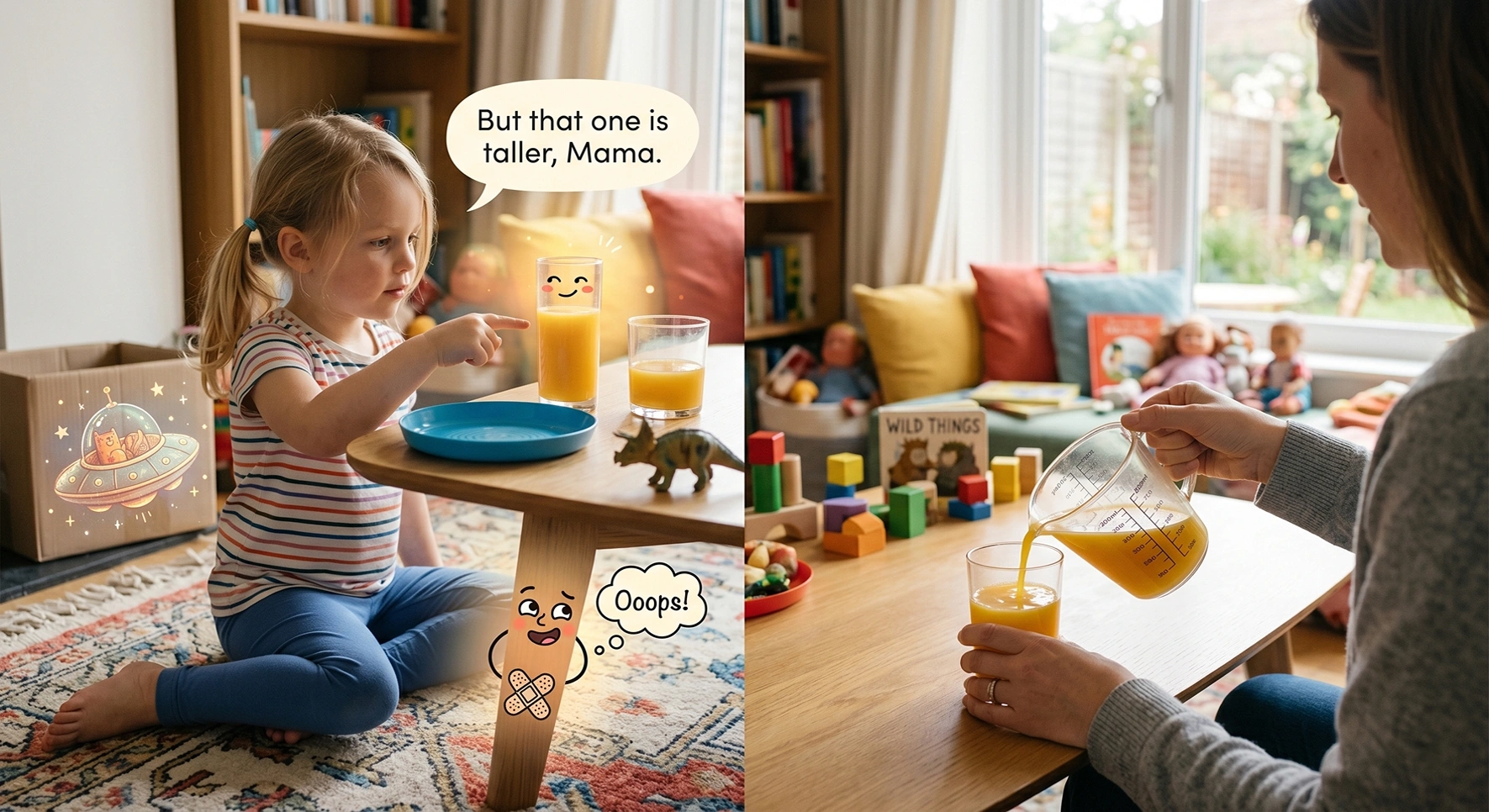
You pour the same amount of juice into two different shaped glasses. Your four-year-old immediately insists one has more. You explain it calmly. She's unconvinced. You try again. Still no. She looks at you with total confidence and says, "But that one is taller, Mama."
Before the frustration sets in pause. Nothing is wrong. What you're watching is not stubbornness. It is the completely normal, predictable way a young child's mind works at this exact stage of life. And once you truly understand it, your child will start making a lot more sense.
The World Is Alive to Them Literally
Between ages three and seven, children genuinely believe that the world around them has feelings and intentions. The sun is happy today. The wind is being naughty. That rock was mean for getting in the way. These aren't cute stories they are real explanations in your child's mind, and they make complete internal sense.
A moment you might recognise
Your son trips over the coffee table and dissolves into tears partly from pain, mostly from outrage. "The table HIT me!" he wails. And he means it. In his mind, the table made a choice. He is not being dramatic. He is being six.
This way of seeing the world is the same engine that powers extraordinary imagination at this age. It's why a cardboard box becomes a spaceship, why a stick becomes a sword, why your child can play alone for an hour in a world entirely of their own making. It's not something to fix it's something to protect, because it fades naturally as they grow.
They Can't See Your Point of View Yet
Young children seem unable to consider someone else's perspective and that's because, right now, they genuinely can't. Not fully. Their brain is not yet equipped to hold their view of the world and yours at the same time. To them, their experience is the world.
This is why they cover their eyes and think you can't see them. Why they interrupt your conversation without guilt. Why they describe an event from the middle because in their mind, you already know the beginning. It is not selfishness in any moral sense. It is simply where they are, developmentally, right now.
Empathy cannot be demanded into a child. It emerges as the brain develops and what you model today is what they'll have the words for tomorrow.
The Logic Behind Their “Illogical” Arguments
Young children judge the world almost entirely by what they see in the present moment. If it looks different, it is different. If it feels bigger, it is bigger. Abstract logic the kind adults use automatically is still under construction.
This is the same reason a fussy eater refuses a familiar food in an unfamiliar bowl. Or why a changed routine feels catastrophic. Or why losing a game feels like a verdict on who they are, not just the outcome of a round. These aren't separate quirks. They all come from the same place: a mind anchored to what it can see, predict, and control right now.
The Shift Nobody Warns You About
Around age seven, quietly and without announcement, something changes. The child who couldn't understand the water now sees it instantly. The child who interrupted every story begins to listen and track. The relentless questioning settles into something more focused they're not just collecting facts anymore, they're starting to connect them.
But even as logic develops, children at this age still learn best through experience through doing, touching, building, and playing not through being told. Concepts become real when a child can interact with them. This is true at five. It is still true at nine.
A thought for parents
The stories you tell your child at this age stay with them longer than you think.
Children at this stage don't just listen to stories they live inside them. A story told by a parent, with a character they recognise and a world that feels made just for them, lands in a completely different way than anything else. Aiino's Magical Moments lets you become that storyteller choosing the characters, the values, the adventure and bringing it to life for your child in a way that is personal, warm, and genuinely theirs.
→ Explore Magical Moments at aiino.ai
Your child is not behind. They are not broken. They are not difficult. They are becoming right on schedule, in exactly the way a child their age is supposed to. And the more you understand what is actually happening in that remarkable mind of theirs, the better placed you are to be exactly what they need.
Not a perfect parent. Just an informed one.