A child’s confidence is built when their early attempts at independence and mastery are met with encouragement of their effort, rather than just the final result. Praising persistence teaches them they are capable of navigating hard things.
A child’s confidence is built when their early attempts at independence and mastery are met with encouragement of their effort, rather than just the final result. Consistently stepping in to do things for them, or praising them with fixed labels like "you're so smart," quietly teaches them to fear failure. Praising their persistence teaches them that they are capable of navigating hard things.
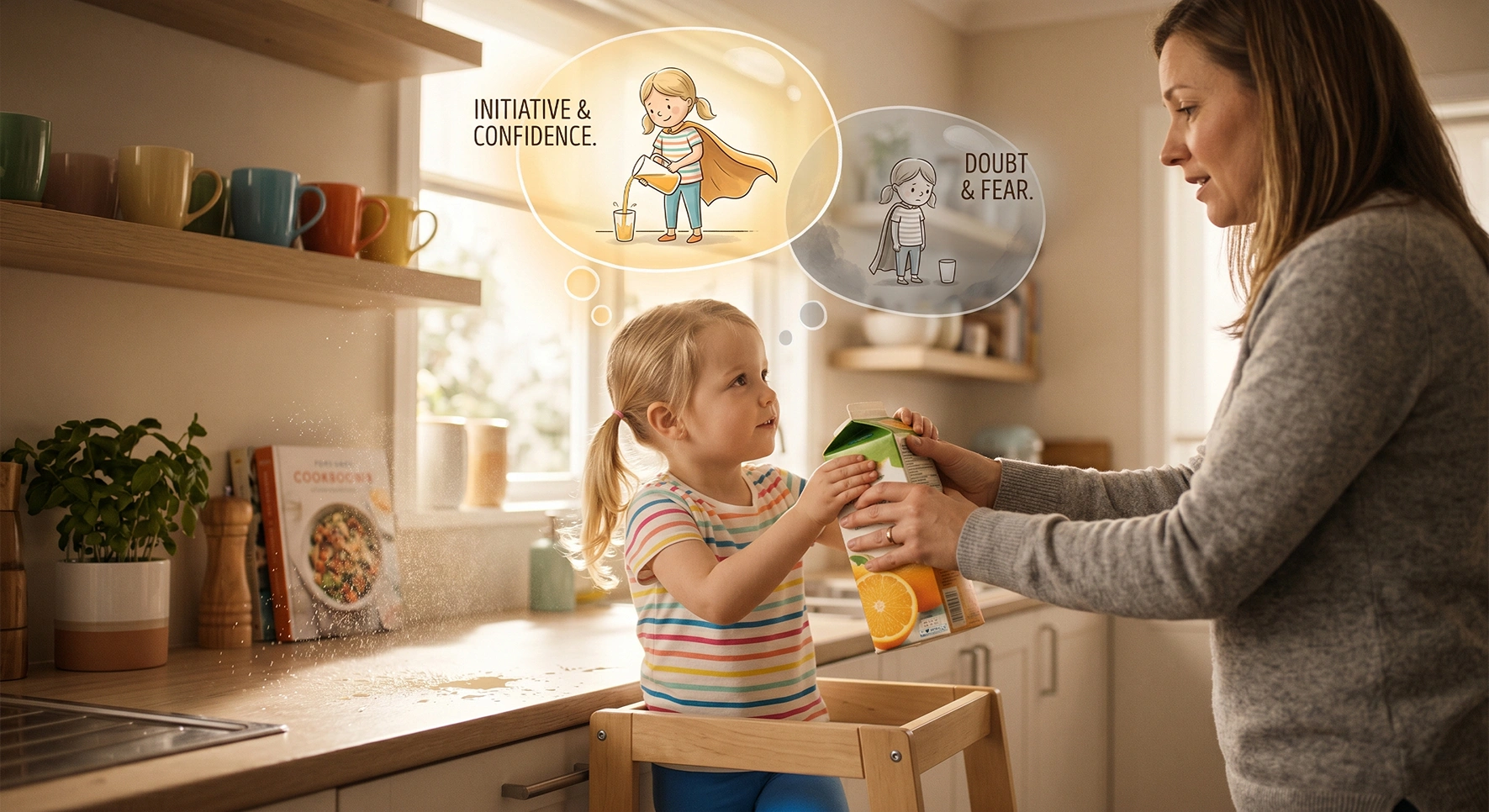
Your five-year-old announces she wants to pour her own juice. She's spilled before. You know she'll probably spill again. You reach for the carton, and she pulls it back. "I can do it myself."
This moment, frustrating as it sometimes feels, is one of the most important things that will happen in your child's development this year. What looks like stubbornness is actually something much more significant: your child is testing whether she is the kind of person who can do things.
The Question Every Young Child Is Secretly Asking
Between ages three and five, children are quietly working on one of the most fundamental questions of their early lives: Am I allowed to want things? Am I allowed to try? When they take initiative starting projects, making choices, attempting tasks and the response from the world around them is warm and encouraging, they develop something essential: a sense that their actions matter.
When that initiative is consistently met with criticism, dismissal, or being simply done for them, something quieter but more lasting develops too. A hesitation. A habit of waiting for permission. A shrinking of the space they feel entitled to occupy.
The child who is never allowed to try will eventually stop wanting to. Not because they lost interest, but because they lost faith in themselves.
The Six-Year-Old Who Needs to Win
Around age six, the stakes shift. Children move from wanting to try things to wanting to be good at them. They become intensely aware of how they measure up to peers, to older siblings, to their own expectations. The child who falls apart when they lose a game, who crumples when their drawing isn't praised, who refuses to try something new in case they fail this child is not being dramatic.
They are in the middle of a developmental battle between feeling capable and feeling inadequate. Every small success is a brick. Every dismissal or comparison is one taken away. This is why the stakes of how you respond to effort not just results are so high at this age.
A moment you might recognise
Your seven-year-old works on a drawing for twenty minutes, then holds it up. You're busy. You say "nice" without looking. They put it face-down on the table and don't show you another drawing for two weeks. They weren't looking for approval. They were looking for evidence that what they made was real.
What This Looks Like in Everyday Behaviour
The child who gives up the moment something is hard is not lazy they have learned that effort and failure feel the same, so why try. The child who needs constant reassurance is not insecure by nature they haven't yet had enough experiences of trusting their own judgement. The perfectionist who won't hand in work until it's flawless is not ambitious they're terrified of being found inadequate.
All of these patterns are workable. None of them are fixed. They are the natural result of a developmental stage that is exquisitely sensitive to how the adults around a child respond to their attempts at the world.
Praise That Builds and Praise That Quietly Undermines
"You're so clever" feels like a compliment. But it ties a child's identity to a fixed trait. When they then fail at something, the conclusion is devastating: maybe I'm not clever after all. The praise that actually builds confidence at this age is specific, process-focused, and honest. "I saw how hard you kept going even when that part was tricky" builds a child who knows they can persist. That's a different child entirely.
A thought for parents
Knowing what your child is working on emotionally changes how you show up for them.
Aiino's Parental Intelligence gives you visibility into your child's digital learning patterns what they're curious about, where they're spending their time, how they're engaging. It's not surveillance. It's understanding. And at a stage where your child's confidence is being quietly shaped every day, understanding them more deeply is one of the most important things you can do.
Explore Parental Intelligence at aiino.ai
Your child's confidence is not fixed. It is being built or quietly chipped at in a hundred small moments every day. The good news is that you are the architect of more of those moments than you probably realise. And knowing that is the first step to using them well.