Artificial Intelligence is software that learns from examples rather than following a fixed set of rules. Traditional software does exactly what it is told. AI software is trained on enormous amounts of data and learns to recognise patterns, make predictions, and generate responses.
Quick Answer
Artificial Intelligence is software that learns from examples rather than following a fixed set of rules. Traditional software does exactly what it is told. AI software is trained on enormous amounts of data and learns to recognise patterns, make predictions, and generate responses. It is not intelligent in the human sense. It is a very sophisticated pattern-matching and pattern-generating system.
Your six-year-old has asked what AI is. Or your eight-year-old has heard it at school and come home with half an explanation and several follow-up questions. Or you have realised that your child uses AI every single day and you would like to be able to explain what it actually is. This is the clear explanation. No computer science degree required.
The one-sentence explanation that actually works
AI is software that learns from examples. That is the core of it. Traditional software is programmed with explicit rules. AI software is trained on vast amounts of data and learns to recognise patterns in those examples that it can then apply to new situations. A traditional spam filter is programmed with a list of words that indicate spam. An AI spam filter is shown millions of examples and learns the patterns that distinguish them.
The three types of AI your child already encounters
Recommendation AI: when Netflix suggests what to watch next, when YouTube decides what video plays after the current one. This is AI trained on the behaviour of millions of users, learning patterns that predict what a specific type of person will engage with next.
Recognition AI: when your phone unlocks when it sees your face, when a voice assistant understands what you said. This is AI trained on millions of images or audio recordings, learning to recognise the patterns that identify a face, a voice, or a word.
Generation AI: when a chatbot generates a response to a question, when AI creates an image from a text description. This is the newest type - AI that has learned the patterns of human language well enough to generate new examples that follow those patterns.
What AI cannot do - the genuinely important limits
AI does not understand anything it produces. A language model that generates a paragraph about volcanoes has not understood volcanoes. It has learned the patterns of how text about volcanoes is written and generated new text that follows those patterns. This is why AI can be confidently wrong in ways that feel completely authoritative.
AI has no values of its own. It reflects the values embedded in the data it was trained on. AI has no genuine curiosity, creativity, or judgement. It can produce outputs that look like these things. It cannot experience them.
"AI is not intelligent in the way humans are intelligent. It is extraordinarily good at finding patterns in data and generating new examples of those patterns. This makes it genuinely powerful and genuinely limited in ways children need to understand."
How to explain AI to a child aged 5-9
For a five or six-year-old: "AI is a computer program that has looked at millions of examples of things and learned the patterns in them. When you ask it a question, it uses what it learned to give you an answer. Like if you read a million books and someone asked you to write a story - you would use what you learned from all those books."
For a seven or eight-year-old: add the limits. "But here is the thing - it does not actually understand what it is saying. It is matching patterns. So sometimes it can say something that sounds completely right but is actually wrong. That is why we always check what AI tells us."
THE CONVERSATION THAT HELPS MOST
Your eight-year-old asks an AI chatbot a question about history and takes the answer as fact without checking. You explain: "AI answers sound very confident even when they are wrong. It does not know the difference between right and wrong. It is just generating text that patterns like an answer. Let us look up what it said and see if it checks out." You look it up together. One detail is slightly off. The child learns from experience that AI requires checking.
AI ARENA - AIINO
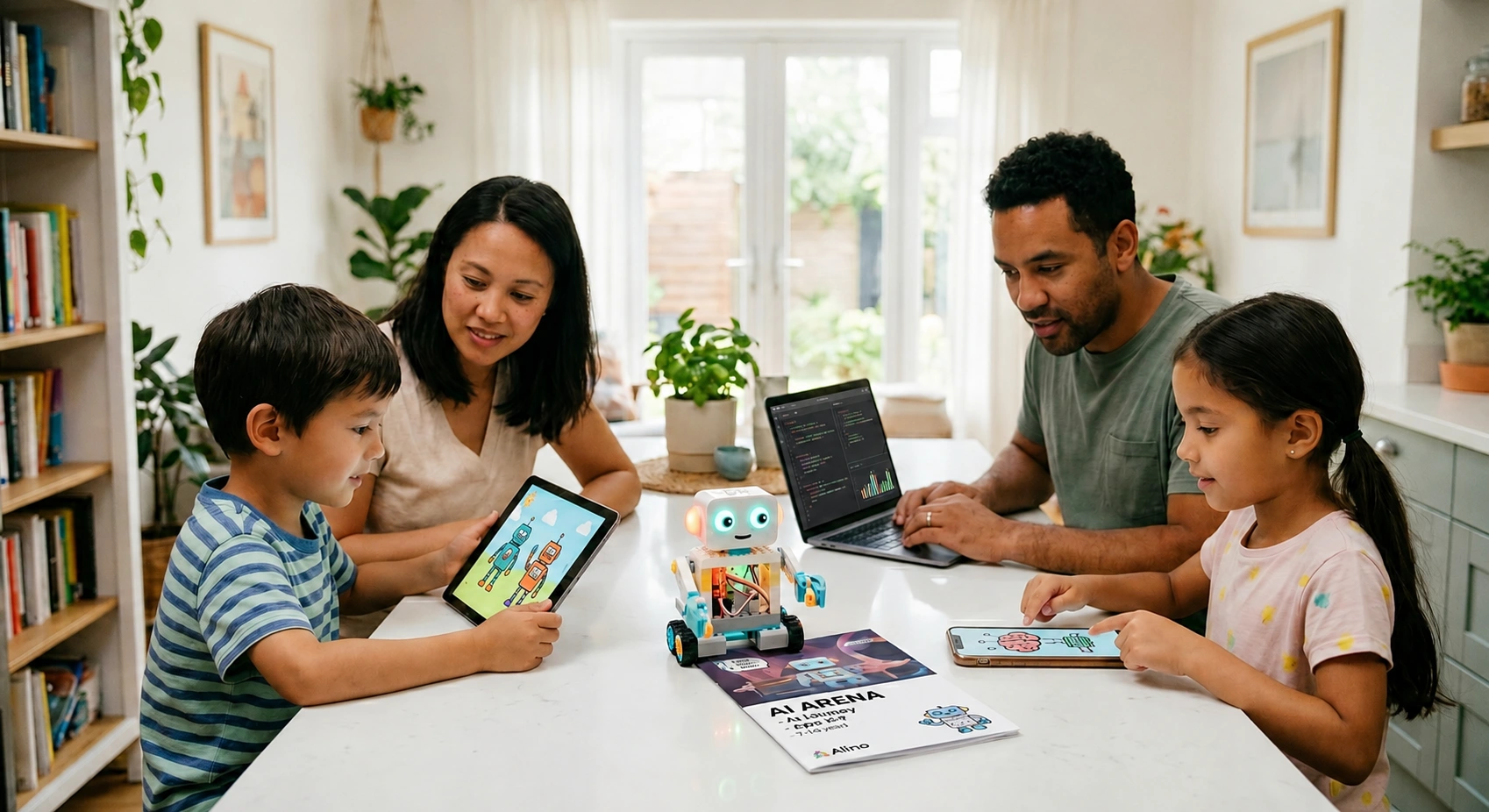
AI Arena teaches children what AI is, how it works, and how to think about it through videos, stories, and interactive quizzes.
Understanding AI is increasingly essential for navigating the world children are growing up in. AI Arena on Aiino builds this understanding from the ground up - age-appropriate, honest about both capabilities and limitations, and built specifically for children aged 3-9.
Explore AI Arena free at aiino.ai
The most important thing a child can learn about AI is not how to use it - they are already using it everywhere. It is how to evaluate it. The habit of checking, questioning, and maintaining human judgement alongside AI outputs is the skill that defines whether a child is served by AI or simply subject to it.