The brain does something completely different when it explores rather than watches. Here's what that difference actually looks like.
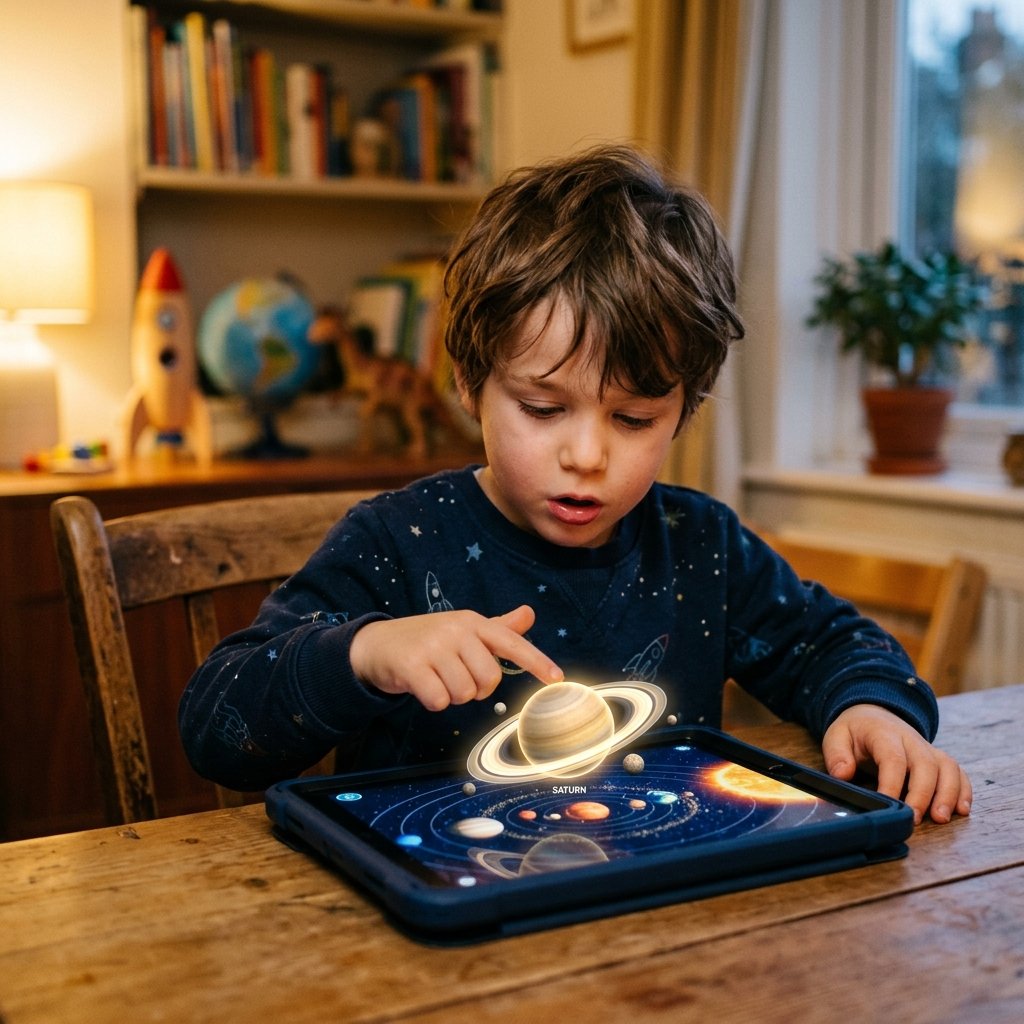
Put a video of the solar system in front of a six-year-old and a 3D model of the solar system they can spin, zoom, and ask questions about. Both contain the same information. Both take roughly the same amount of time. What they produce in the child's brain is not the same thing at all.
This is not a minor distinction. It goes to the heart of how children's brains actually learn — and why so much of the content children consume digitally produces so little that lasts.
What the brain does during passive video — and what it doesn't do
When a child watches a video, the brain is in a receiving mode. Information arrives in a pre-packaged sequence — the narrator decides what to show, in what order, at what pace, with what emphasis. The child's job is to follow. The brain's job is to receive and retain.
Retention from passive video, without active engagement or repetition, drops significantly within 24 hours. This is not a flaw specific to children — it is how declarative memory works. Information heard or watched without being processed actively moves from working memory to long-term storage at a much lower rate than information that required the learner to do something with it.
What passive video also does not produce: questions. A well-edited video explains things clearly. It answers questions the child didn't yet have. The child receives the answer without forming the question — which means the neural pathway that connects curiosity to discovery, one of the most powerful learning loops available, is bypassed entirely.
A video answers questions the child didn't ask. An interactive 3D model generates questions the child didn't know they had. That difference is the difference between consuming information and building understanding.
What the brain does during 3D exploration — and why it's different
When a child rotates a 3D model, zooms into a feature they noticed, and asks a question about what they're seeing, the brain is in a completely different mode. Multiple systems are simultaneously active: the visual system processing the object from a self-chosen angle, the spatial reasoning system constructing a mental model, the working memory system holding what's already been discovered alongside what is currently being seen, and the language system formulating a question.
This is active learning in the precise sense. The child is not following a pre-packaged sequence — they are directing their own exploration. What they look at, what they rotate to see, what they zoom into, what they choose to ask — all of this is determined by their curiosity rather than an editor's decision. The learning that follows is theirs in a way that watched learning is not.
The research on spatial learning in early childhood is consistent: children who engage with 3D representations of objects develop stronger spatial reasoning, better comprehension of complex systems, and more durable knowledge of the subject matter than children who engage with the same content through 2D or video formats. The active spatial engagement is doing the work.
The question that changes everything
The moment that distinguishes 3D exploration from video most clearly is the question. When a child is watching a video about the solar system and something surprises them — they cannot pause and ask what it is. The video continues. The curiosity has nowhere to go. It either produces a question that gets answered later, or it dissipates unanswered.
When a child is exploring a 3D model of the solar system and something surprises them, the question is immediate and the answer is immediate. The neural connection between curiosity and discovery happens in real time. "Why is Saturn's ring so flat?" asked at the moment of noticing it, answered at the moment of asking — this is the learning loop that builds both knowledge and the disposition to keep asking.
The disposition to keep asking is, arguably, worth more than any specific piece of knowledge the child might acquire. A child who has learned that curiosity leads somewhere — that asking produces answers, that exploring produces discovery — is building a relationship with learning that serves them across every subject they ever encounter.
WATCH THE DIFFERENCE
Two children. Both learn about the human heart this week. The first watches a five-minute animated video — clear, well-produced, accurate. The second spends the same time with a 3D model of the heart, rotating it, zooming into the valves, asking the AI companion "but what pushes the blood through?" The first child can report what they watched. The second child cannot stop talking about it at dinner — not because they memorised more, but because they discovered it themselves.
What this means for screen time choices
The distinction between passive and interactive digital content is not a minor preference — it is a developmental one. The brain that spends its screen time receiving builds habits of receiving. The brain that spends its screen time exploring builds habits of exploring. These habits compound across years.
A child who has spent their formative screen time years in the passive mode develops a default relationship with digital content as something that happens to them. A child who has spent those years in the active, exploratory mode develops a default relationship with digital content as something they direct. The same screen. The same amount of time. Completely different cognitive formation.
PLAY BUDDY — AIINO
Play Buddy is built entirely on the interactive exploration model.
Every 3D model on Play Buddy — rockets, animals, the human heart, ecosystems, weather systems — is designed to be rotated, zoomed, explored from any angle, and questioned. The AI companion responds to the child's specific question at the moment they ask it. The experience cannot be completed by simply being present. It requires the child's direction. That is the design intention — because that is what learning actually looks like. Free to try at aiino.ai.
Try Play Buddy free at aiino.ai
The next time a child is given screen time, the most useful question is not how long — it is what does this require of them? Content that requires nothing produces nothing. Content that requires curiosity, direction, and active engagement produces exactly those things. The 3D model that generates a question a child asks at dinner is doing something the video that was watched and forgotten never did.