Most children spend two or more hours a day on a screen. What they do during that time matters more than how long they do it. Research shows passive screen use — watching videos that play automatically, scrolling through content without making choices — produces different brain outcomes than active screen use.
Most children between ages 3 and 9 spend two or more hours a day on a screen. What they do during that time matters more than how long they do it. Research consistently shows that passive screen use — watching videos that play automatically, scrolling through content without making choices — produces measurably different brain outcomes than active screen use, which requires the child to respond, decide, and engage. Passive consumption is associated with lower executive function, reduced attention capacity, and weaker language development. Active, interactive engagement — where the child drives what happens — is associated with stronger cognitive outcomes and improved learning. The screen is not the problem. What is happening on it is.
Ask a group of parents about screen time and you will hear the same debate every time. How much is too much? Is an hour a day fine? What about weekends? Should we have screen-free days?
These are all reasonable questions. They are also the wrong questions. The research that has emerged over the past several years tells us that duration is far less important than what we have been measuring it. The variable that actually predicts developmental outcomes is not how long the screen is on. It is what the child is doing while it is on.
There is a significant and measurable difference between a child who is watching videos that play one after another without any input, and a child who is making decisions, building something, asking questions, and responding to what happens on screen. The first child is consuming. The second child is learning. The same screen. Different outcomes. Completely different effects on the developing brain.
The Real Screen Time Question Parents Are Not Asking
The screen time debate has been dominated by a single metric: minutes per day. The American Academy of Pediatrics has issued guidelines around it. Schools send letters home about it. Parents feel guilty when they exceed it and relieved when they do not. The number has become the measure of whether screen use is responsible or reckless.
But researchers who study children and screens have been pointing out for several years that this framing misses the most important variable. Dr. Jenny Radesky, a paediatrician at the University of Michigan and one of the leading researchers in this field, has argued consistently that content and context matter far more than time. Her work, alongside a growing body of peer-reviewed research, shows that the effects of screen time on young children depend almost entirely on what they are doing, not how long they are doing it.
The useful question is not "how long was my child on a screen today?" The useful question is "what was my child's brain doing while they were on that screen?" The answer to the second question is what actually shapes development.
What Passive Screen Time Actually Does to a Young Brain
Passive screen use — watching videos, following content that is served to you automatically, viewing without responding — is not neutral for a young child's brain. The research shows that it has specific and measurable effects on cognitive development, and most of them work against what parents are trying to build.
Executive function is weakened
Executive function is the collection of brain skills that allows a child to plan, focus, wait, manage impulses, and switch between tasks flexibly. It is one of the strongest predictors of school success and adult outcomes that developmental research has identified. A 2024 study published in Academic Pediatrics tracked 315 preschoolers across three years and found that children in the high screen time group — averaging over six hours per day — scored significantly lower on tests of inhibitory control and executive function at age five and a half than children in the low screen time group. The relationship was dose-dependent: more passive screen time, worse executive function outcomes [1].
Attention capacity is affected
A 2026 study published in Frontiers in Psychology found that passive screen time — particularly fast-paced content that changes scenes quickly — strengthens a certain type of automatic attention while reducing sustained, focused attention. The child who watches a lot of fast-paced passive content gets better at responding to flashing, changing stimuli, and worse at the kind of deep, sustained focus that reading, listening, and learning require [2].
Language development is slowed
Language develops through back-and-forth interaction — what researchers call "serve and return." A child says something, an adult responds, the child responds back. This conversational exchange is the engine of language acquisition. Passive screen watching does not produce serve and return. It produces one-way input. Research published in Pediatrics in 2023 found longitudinal associations between passive screen use in preschool-aged children and weaker reading outcomes at follow-up [3].
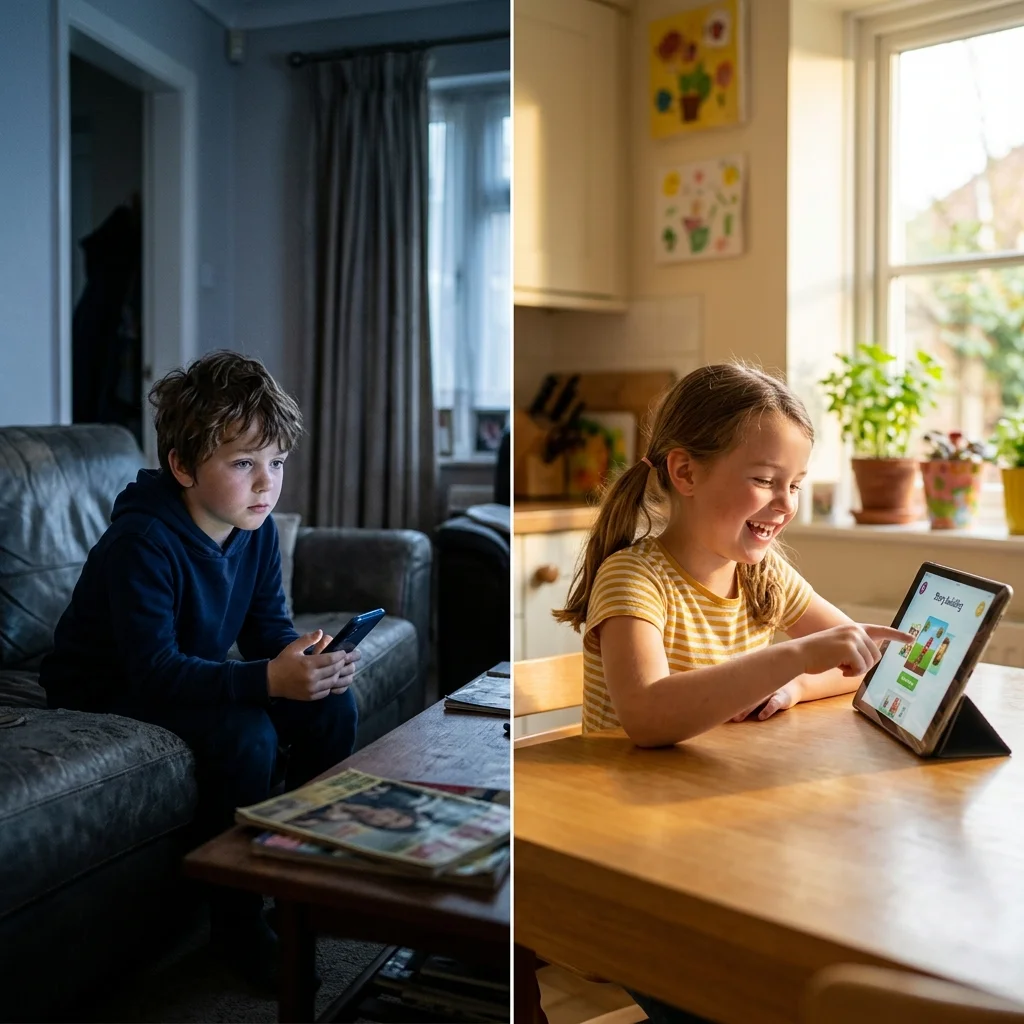 Active screen time engages multiple creative and cognitive centers of a child's brain, whereas passive scrolling reduces executive function and language interaction.
The Autoplay Problem — How It Works and Why It Matters
One of the most significant drivers of passive consumption in children's screen use is autoplay — the feature that begins the next video or episode automatically, without the child choosing it. Autoplay removes the one natural stopping point available: the moment between pieces of content when a decision could be made.
Research published in December 2024 classified autoplay as an "attention capture damaging pattern" — a design feature specifically engineered to extend engagement by eliminating agency. The study found that autoplay features are "one of the most common and harmful" such patterns in streaming platforms, precisely because they undermine the user's sense of control [4]. This research was conducted on adult users. The effects on children — whose impulse control and capacity to step back and evaluate their own behaviour are still developing — are considered significantly more pronounced.
WHAT THIS LOOKS LIKE IN PRACTICE
Your child watches one video. It ends. Before they can think "should I keep watching or do something else?" the next video has already started. The question was never asked. The decision was never made. Over months and years of this pattern, the brain adapts: the habit of deciding what to do next, of choosing engagement rather than receiving it, weakens. The child who never had to choose what to watch next is a child who has less practice choosing what to do with their attention.
What Active Screen Time Looks Like and Why It Is Different
Active screen use is not simply "educational content." A child watching an educational documentary passively is still a passive consumer. The distinction is about what the brain is required to do, not what the content is about.
Active screen engagement requires the child to respond, decide, and affect what happens. This might mean making choices that change a story. It might mean answering questions that adapt the difficulty of a game. It might mean exploring a subject by asking their own questions rather than receiving a curated sequence of information. The common element is that the child's input shapes what happens next. They are not watching — they are participating.
“The child who drives what happens on screen is building different capacities from the child who receives what is served to them. The same device. Completely different developmental outcomes.”
— Frontiers in Psychology, 2026
A 2025 research study published in Scientific Reports found that children who used interactive learning systems — where their input drove the pace and direction of content — showed average improvement rates of 24 to 28 percent in core academic subjects compared to pre-test scores. The interactivity was identified as the key variable: children who engaged with adaptive, responsive content outperformed those who received the same information passively [5].
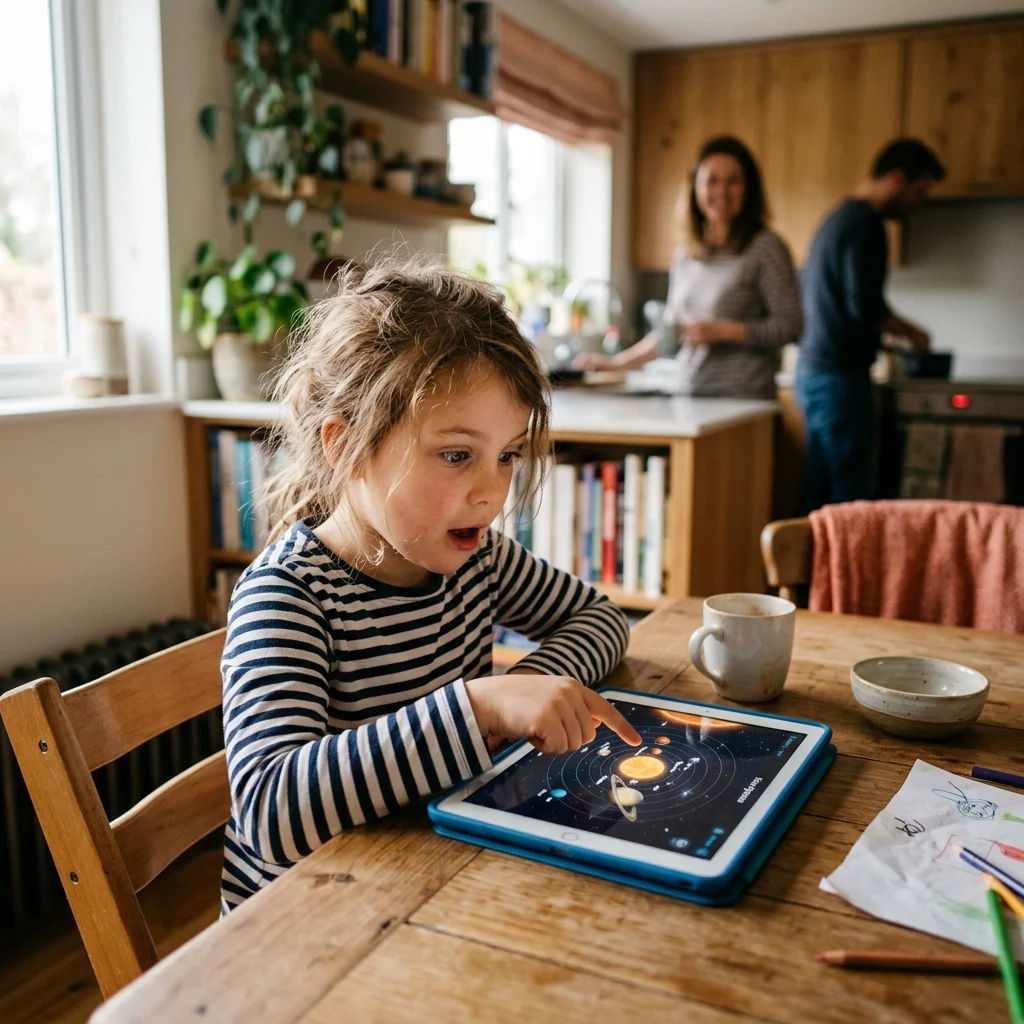 When children drive what happens on screen — like exploring interactive 3D models or directing characters — they build stronger spatial and causal reasoning skills.
The Executive Function Connection — Why It Matters for School
Executive function includes three core skills. Working memory — holding information in mind while using it. Inhibitory control — managing impulses, resisting distractions, waiting. Cognitive flexibility — switching between tasks and adjusting to new rules and situations. Research consistently finds that these three capacities predict school success more reliably than IQ, and that they are built through specific types of experience.
The experiences that build executive function have one thing in common: they require the child to manage themselves in relation to a challenging, responsive task. A game that requires waiting for the right moment. A problem that requires holding several pieces of information in mind simultaneously. A story that requires tracking characters across scenes. A conversation that requires listening before responding.
The experiences that weaken executive function also share a common feature: they require nothing. A stream of content that plays regardless of what the child does. A feed that refreshes automatically. A video that continues whether the child is watching or not. These experiences not only fail to build executive function — the 2024 meta-analysis in ScienceDirect found that high screen time was associated with executive function deficits across multiple cognitive domains [1].
What the Research Says About Learning From Screens
The research on whether children can genuinely learn from screen-based content is more nuanced than either side of the screen time debate usually acknowledges. The short answer is: it depends on what they are doing on the screen.
The 2026 study on passive versus active screen time in preschoolers found that the effects on learning were significantly greater in passive users than active users, with passive use showing measurable deficits in auditory processing, auditory memory, and executive function [6]. The same study found that these effects increased with the amount of time spent on passive screens — making the quality of engagement the critical variable.
A meta-analysis reviewed in the UNESCO 2023 Global Education Monitoring Report found that interactive digital tools — games, adaptive software, and content that requires active participation — improved cognitive and learning outcomes in children across multiple studies. The same report noted that passive video-based content showed weaker or inconsistent effects on learning outcomes [7].
How to Tell If Your Child Is Passively Consuming or Actively Learning
You do not need to research every app or platform your child uses. A few simple observations tell you most of what you need to know.
Signs of passive consumption
The content continues without any input from the child. The child could leave the room and come back to find it still running. There is no obvious moment where the child makes a decision or chooses what happens next. The child becomes increasingly disengaged or zombie-like during the session. There is significant distress when the content is stopped — not because the child was invested, but because the stopping creates the first moment of stimulation gap they have experienced in a while.
Signs of active engagement
The child is making visible choices — clicking, responding, selecting. The content changes based on what they do. The child is curious about outcomes: "what happens if I do this?" The child talks about what they are doing while they are doing it, or brings the content into conversation afterward. They can tell you what they did, not just what they watched. The session has a natural endpoint that the child recognises.
A QUICK TEST
Cover the screen for ten seconds while your child is using it. If they notice immediately and seem invested in getting back to what they were doing, they were probably active. If they barely notice, or if the content just kept going without them, they were probably passive. This is not a scientific measure — but it is a surprisingly accurate one.
Is Your Child's Screen Time Active or Passive?
Most screens capture a child's attention without checking their understanding. Take our 2-minute diagnostic quiz to evaluate your child's digital patterns, identify autoplay traps, and receive actionable insights to maximize active learning.
Start Screen Time & AI QuizPractical Steps to Shift the Balance
Turn off autoplay everywhere
This is the single highest-impact change you can make with the least effort. On YouTube, Netflix, and most streaming platforms, autoplay can be disabled in settings. When autoplay is off, every new piece of content requires a choice. The choice is the developmental moment. You do not need to reduce screen time to make this change. You need to change one setting.
Ask one question when a session ends
After screen time — whatever the content — ask your child one open question about what they did or experienced. Not "what did you watch" but "what happened?" or "what did you decide?" or "what surprised you?" This question does several things simultaneously: it creates a serve and return language moment, it moves the experience from passive consumption to something discussed and integrated, and it signals that what they do on screens is interesting to you rather than something to be managed.
Choose platforms that require response
When evaluating any digital product for your child, ask one question: does this content continue if my child does nothing? If yes, it is designed for passive consumption. If no — if the content waits for the child, responds to the child, changes based on what the child does — it is designed for active engagement. This single criterion separates the majority of low-quality children's content from the minority that genuinely supports development.
Co-engage sometimes
Sitting alongside your child for part of a screen session — not to supervise, but to be genuinely curious alongside them — converts a passive experience into an active one almost automatically. Your presence and interest generate conversation, which generates serve and return, which generates language and cognitive benefit. You do not have to do this every time. Once or twice a week makes a measurable difference.
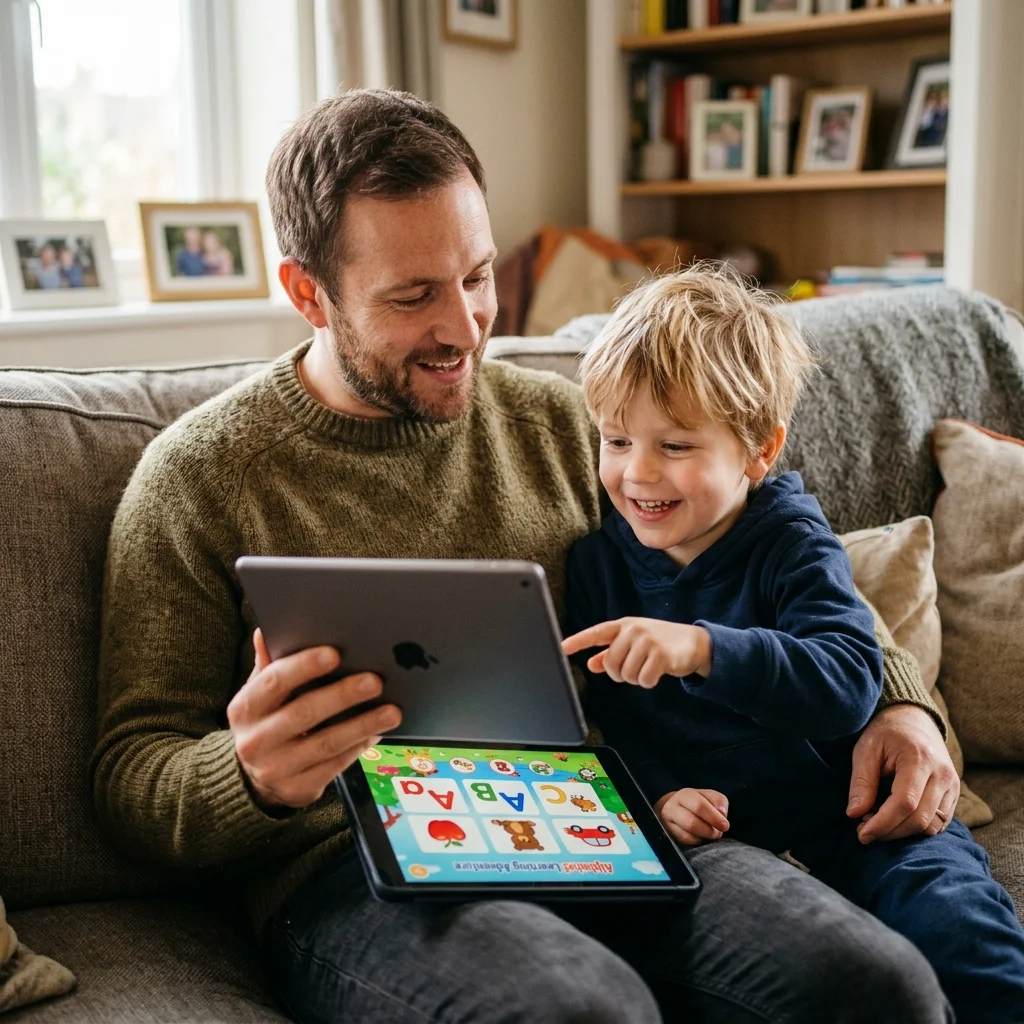 Co-engaging with your child during screen sessions transforms device usage into a shared developmental and bonding moment.
Help Shape the Future of Active Learning
Join our exclusive Founding Member program. Get early access to new interactive modules, direct input into our product roadmap, and lifetime pricing options.
Research Citations
- [1]Bustamante, J.C., et al. (2024). "Associations Between Preschooler Screen Time Trajectories and Executive Function." Academic Pediatrics, Vol. 25(1). View source →
- [2]Gueron-Sela, N., et al. (2026). "Passive and active screen time relate differently to attention in preschool children." Frontiers in Psychology, 17:1737937. View source →
- [3]Lin, M., Reich, S.M., Schauer, J., et al. (2023). "Longitudinal associations between screen use and reading in preschool-aged children." Pediatrics, 151(6):e2022059804. View source →
- [4]Levi, A., et al. (2024). "An Experimental Study of Netflix Use and the Effects of Autoplay on Watching Behaviors." arXiv:2412.16040. View source →
- [5]Pan, J., et al. (2025). "Design and evaluation of children's education interactive learning system based on human computer interaction technology." Scientific Reports, 15:7124. View source →
- [6]Mostafa, A., et al. (2026). "The effect of active versus passive screen time on learning disabilities in preschool children: a cross-sectional study." The Egyptian Journal of Otolaryngology, 42:13. View source →
- [7]UNESCO (2023). "Technology in Education — 2023 Global Education Monitoring Report." United Nations Educational, Scientific and Cultural Organization. View source →