Quick Answer
Some kids cry easily because the part of the brain that controls big feelings is still being built. In kids under nine, an emotion hits at full strength before the brain can slow it down. Some kids are also born more sensitive, so they feel everything more deeply, both good and bad. Crying easily is not weakness or bad behavior. It is a normal stage that almost always fades with age. What helps most is staying calm and naming the feeling out loud before trying to fix it. The sensitivity behind the tears often grows into empathy and strength.
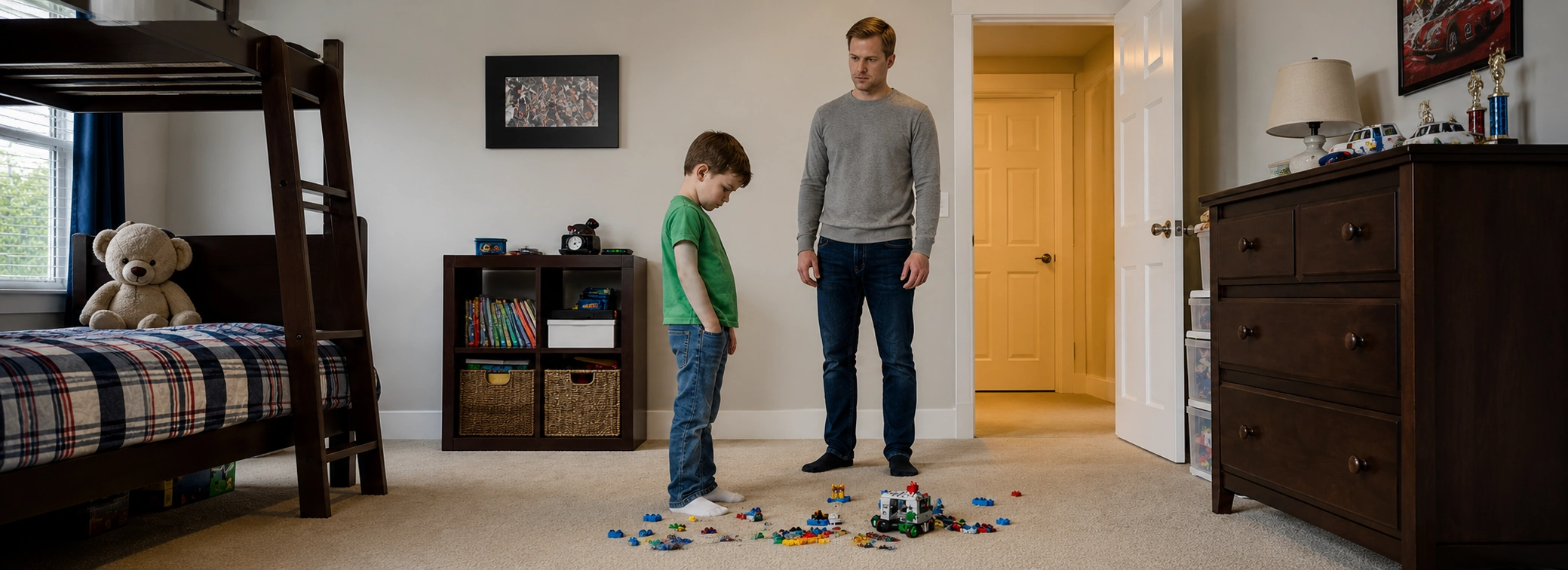
A six-year-old is coloring at the kitchen table. The crayon slips, and one line ends up outside the edge of the drawing. That is the whole event. But within seconds there are real tears: the shaking voice, the crumpled face, the look of someone to whom something genuinely sad has just happened. To a grown-up watching, it looks like a huge reaction to a tiny problem. To the kid, the size of the reaction matches the size of the feeling exactly. Nothing is being faked. Nothing is being stretched for effect. The feeling really is that big.
 To a grown-up it looks like a huge reaction to a tiny problem. To the kid, the feeling really is that big.
If a kid seems to cry over almost anything (a lost game, a wrong-colored cup, a friend who said no), there is a reason, and it is not a flaw in the kid. It is how a young brain is built. Here is what is actually going on, and what makes it easier.
The feeling shows up before the brake
The brain has a control center near the front, just behind the forehead. Think of it as a brake. It is the part that lets a person pause, ask “is this really worth it,” and shrink a reaction so it fits the moment. In adults, that brake works fast and mostly without effort.
In young kids, the brake is barely built. The part of the brain that handles this kind of control keeps developing slowly, all the way into the mid-twenties. So a feeling arrives at full volume, and there is no brake yet to bring the volume down. The crying is not too big for the moment. It is the right size for a brain that does not have a dimmer switch yet.
“A young kid crying over something small is not overreacting. Their brain simply has not built the part that makes reactions smaller yet.”
Some kids are simply wired to feel more
Two kids the same age, in the same home, can react completely differently. One shrugs off a scraped knee; the other is in tears over a sticker that peeled. A lot of that difference is something kids are born with. Researchers have a name for it: sensory processing sensitivity.
Kids on the more-sensitive end take in more from the world around them: sounds, faces, moods, small changes most people miss, and they feel all of it more strongly. It is not better or worse than being less sensitive. It is just a different setting on the dial, and a large share of kids are turned up high.
It is not something they choose
A sensitive kid is not trying to be difficult, and they are not doing it for attention. Their nervous system genuinely registers more, so there is simply more to react to. Asking them to “just stop being so sensitive” is like asking someone to stop hearing a sound that is, for them, very loud.
It is not something to fix
This wiring is not a problem to be corrected. As you will see in a moment, the same sensitivity that produces easy tears is closely tied to some of the best things about a kid.
Crying easily is not the same as being weak
The kid who cries at a sad cartoon is often the same kid who notices when a classmate is left out, who cares deeply about fairness, who remembers your bad day and asks if you are okay. The tears and the kindness come from the same place: a system that feels things deeply.
There is something important here that research has shown clearly. Sensitive kids do not just feel the bad more. They respond more to the good, too. In studies of school-age kids, the more sensitive kids did worse when their world felt cold or harsh, but actually did better than less-sensitive kids when they were met with warmth and steady, caring responses. Their sensitivity swings both ways. Met with patience, it becomes a strength.
A MOMENT YOU MIGHT RECOGNIZE
A seven-year-old bursts into tears during a cartoon, the part where the lost dog finally finds its way home. An older sibling laughs at them for crying at a “baby movie.” But this is the same kid who, a week earlier, was the only one in class who noticed a new student sitting alone and went to sit beside them. Same wiring. The tears at the happy ending and the kindness to the new kid come from the exact same place.
Help Shape the Future of Active Learning
Join our exclusive Founding Member program. Get early access to new interactive modules, direct input into our product roadmap, and lifetime pricing options.
 The tears at the happy ending and the kindness to the new kid come from the exact same place.
Why “it’s not a big deal” backfires
When big feelings get waved away with “stop crying,” “it’s nothing,” or “you’re fine,” the feeling does not actually get smaller. It just goes quiet on the outside. Research that looked at how adults respond to kids’s emotions found that a brush-off, dismissing style is linked to more emotional trouble down the line, including a harder time managing feelings.
The reason is simple. A kid whose feelings are regularly dismissed does not learn that the feeling was small. They learn that the feeling was unwelcome. So next time, they hide it. And a hidden feeling is much harder to help with than one that is out in the open.
“Telling a kid a feeling is no big deal does not make the feeling smaller. It just teaches them to hide it.”
What actually helps: name it before you fix it
The move that works is not fixing. It is naming. Studies that taught adults to notice a kid’s feeling and put simple words to it found that the kids’s own emotional skills improved as a result. Naming a feeling out loud seems to take some of the heat out of it and helps the thinking part of the brain come back online.
It can be as short as a single sentence that describes what you see: “That really hurt.” “You wanted it to work and it didn’t.” “You were having fun and it ended too soon.” No solution attached. Just proof that someone gets it.
The order matters: feeling first, fixing second
Most of us jump straight to the fix: “it’ll be okay, we can try again.” That is not wrong. It is just out of order. A kid who feels understood first can actually hear the reassurance second. Flip it around: “That was so disappointing” before “it’ll be okay”, and the same words land completely differently.
Staying calm is doing something
In the middle of a hard cry, a kid’s brain cannot process logic the way a calm brain can. This is why reasoning and lectures bounce right off in the moment. It is not stubbornness. The thinking part is temporarily flooded.
So the most useful thing a nearby adult can do can feel like doing nothing: stay calm, stay close, and wait. A steady adult acts like a borrowed brake until the kid’s own one comes back. The cry will rise, peak, and come down. It always does. Calm is not passive. It is the active ingredient.
A MOMENT YOU MIGHT RECOGNIZE
Bath time. A four-year-old is sobbing because the water went down the drain and they “weren’t finished watching it.” There is no fixing this. The water is gone. So instead of explaining how drains work, the adult sits down on the bathroom floor and says: “You really liked watching the water swirl. It’s sad when something fun ends.” The crying slows. Not because anything changed, but because someone got it.
Is Your Kid's Screen Time Active or Passive?
Most screens capture a kid's attention without checking their understanding. Take our 2-minute diagnostic quiz to evaluate your kid's digital patterns, identify autoplay traps, and receive actionable insights to maximize active learning.
Start Screen Time & AI Quiz Name the feeling before you fix it, the crying slows not because anything changed, but because someone got it.
When it is worth a closer look
Frequent, easy crying is almost always just development, and it fades on its own. But a few patterns are worth a calm conversation with a doctor or another professional who knows kids well.
Look a little closer if the crying seems driven by constant worry, if a kid cries about things that might happen rather than things that did happen, or if the tears come alongside bigger changes, trouble sleeping, eating differently, stomach aches with no clear cause, or pulling away from people they usually enjoy. None of these mean something is wrong. They simply mean it is worth having someone look at the whole picture, rather than guessing.
What the tears turn into later
Here is the part that is easy to miss while you are handing over yet another tissue. The deep-feeling system behind early tears is the same one that, year after year, tends to grow into empathy, creativity, strong friendships, and a real sense of right and wrong. The crying is just one early, loud expression of it.
Met with patience instead of frustration, that sensitivity does not stay a source of meltdowns. It becomes one of the most valuable things about the person the kid is turning into. The tears are not a problem to fix. They are a sign of a kid who feels deeply, and, handled gently, that becomes a strength they carry for life.
Research Citations
- [1]Highly sensitive kids feel things more strongly, and regulate emotions better when met with warm, responsive relationships (Lionetti et al., Frontiers in Psychology, 2024). View source →
- [2]The prefrontal cortex, which supports controlling and shrinking emotional reactions, develops slowly into the mid-twenties (Fombouchet et al., Social Development, 2023). View source →
- [3]Kids’s emotion-regulation brain circuits are still being built in early childhood (Center on the Developing Kid, Harvard University). View source →
- [4]Helping parents notice, name and validate kids’s feelings improves kids’s emotional skills (systematic review and meta-analysis, Frontiers in Psychology, 2023). View source →
- [5]A dismissing response to kids’s emotions is linked with more emotional problems and poorer emotion regulation (parent emotion-socialization profiles study, 2023). View source →
FOR PARENTS
Kids who feel seen at home carry that security everywhere else.
Aiino’s Magical Moments lets you create personalized stories for your kid, stories where they are seen, valued, and capable. At an age when feeling understood matters most, a story that reflects a kid’s inner world back to them is a simple, powerful gift.